Flanderization is the process by which a legitimate, often fully developed, character becomes a parody of him- or herself.
I believe this is what has happened to the cultural perception of Sherlock Holmes.
 He is portrayed as a brilliant but socially and/or relationally irresponsible individual who redeems himself (reaches “likable character” status) through selective niceness. It seems to me that those who don’t identify directly with Holmes frequently do with Watson, and so any harshness or undiluted rudeness to others is glossed over. Sherlock (BBC iteration is freshest in my mind) has proven his worth by being willing to die for the few he loves.
That action is enough to redeem all his other faults, apparently.
Sherlock’s familiar attitude is well summed up in a painfully honest assessment of another admirer, Jane Eyre, speaking of her employer, Edward Fairfax Rochester.
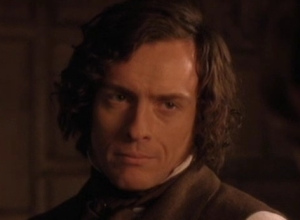 He was proud, sardonic, harsh to inferiority of every description: in my secret soul I knew that his great kindness to me was balanced by unjust severity to many others. He was moody, too; unaccountably so.
…I believed his moodiness, his harshness… had their source in some cruel cross of fate. I believed he was naturally a man of better tendencies, higher principles… I thought there were excellent materials in him; though for the present they hung together somewhat spoiled and tangled.
 As the more Sherlockian of the Watson/Holmes pair, and the more Jane of the Eyre/Rochester pairing, I see a great deal of personal indulgence on both sides.
First, you have an adoring subordinate who revels in the superiority of the other. This is an egotistical indulgence on the part of the writer who is (perhaps) an unacknowledged genius, creating a socially-acceptable display of their deepest hungers and wish-fulfillment.
Then, for Jane’s, or John’s (or Sherlock’s fans) part, they latch so much on to the selective kindness of a man “harsh to inferiority of every description” that they seem to let themselves be flattered at his mere acceptance. It is high praise to escape his harshness, and that awareness only magnifies the felt-kindnesses of a man who actively proves his ability to be kind when he wishes to.
An interesting thing about Sherlock’s kindness is that it is not so much overt choice (“I should be kind to this fellow creature”) as it is his form of need (he needs a mirror, a prism, a case, applause), creating a vacuum for another individual to fill. The reason he has so few connections in his world, so few deep friendships, is because he acknowledges so few needs.
The magic of John and Sherlock’s relationship is that they are both content with what the other is naturally willing to give. It is a nearly effortless exchange.
Most relationships require giving a bit more than we’re ready or comfortable to give, and that is why most relationships grow and shape us. But there’s no denying the rest of an unchallenging, natural friendship. Continue reading »


 Fantasy and wish-fulfillment done well.