My flesh and my heart may fail, but God is the strength of my heart and my portion forever.
Psalm 73:26
Monthly Archives: July 2007
Fewer Doubts = Less (self) Censoring?
Jacques Barzun in A Writer’s Discipline:
[We] transfer a part of our intellectual and emotional insides into an independent and self-sustaining outside [when we write]. It follows that if we have any doubts about the strength, truth, or beauty of our insides, the doubt acts as an automatic censor which quietly forbids the act of exhibition.
Caribou pix (fears about the ANWR herd are a joke)
As in, pictures from family.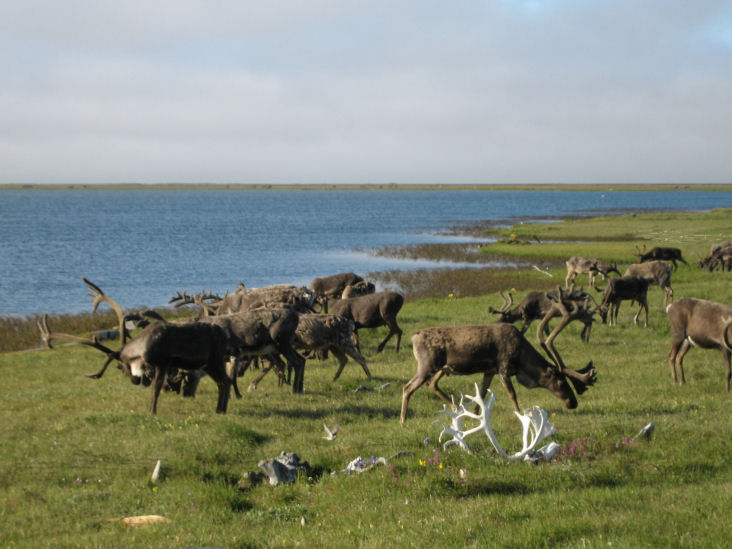
My mother-in-law took these this week. There have been thousands of caribou moving through their property lately.
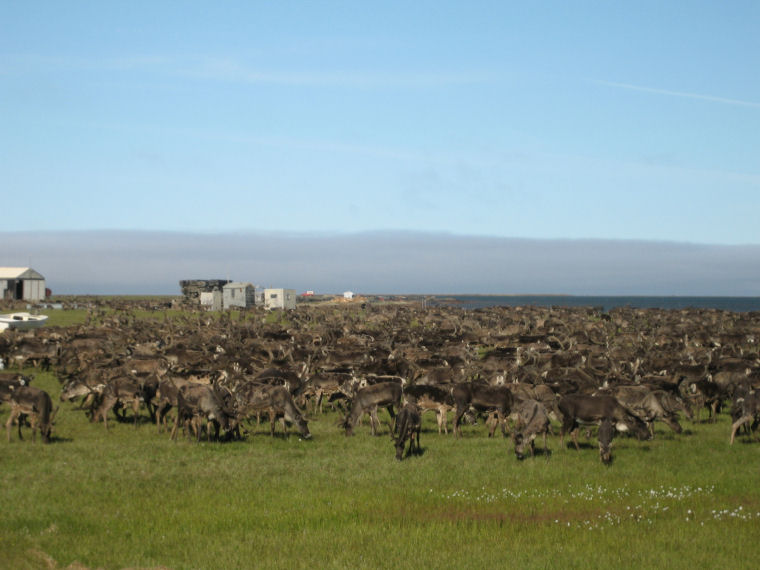
Made me think of two things:
- This must be what the bison herds were like hundreds of years ago.
- Anyone who says the oil industry is hard on caribou (*cough* ANWR *cough*) can’t be looking at the caribou near other oil fields.
(Hard on birds is more accurate, but that’s already been ignored for a recent set-up that went unopposed, as far as I know.)

What to do…(when you can’t do everything you love)
I have just finished a two-week Storytelling workshop with Antoinette Botsford.
It was delightful (as always) to spend so much time with people who value– and enjoy exploring– stories. And then I felt like I always do when I finish a chunk of creative work:
Now what?
I feel I have an aptitude for this. Or, if not an aptitude, sufficient training to make up for the lack.
The challenge, always, is deciding what to do with what I’ve learned. Thankfully (perhaps I should say, as usual), a familiar passage from a story played through my head, and seemed to answer that question.
In Jane Eyre, the title character is offered a position that might have appeared to be beneath her accomplishments. But she evaluated what she was being asked to do:
It was not ignoble– not unworthy– not mentally degrading.
“I accept it with with all my heart.”“What will you do with your accomplishments? What, with the largest portion of your mind– sentiments– tastes?”
“Save them until they are wanted. They will keep.”
Very soon my children will be needing different things from me.
As we begin our transition into schooling I’ve been told that will keep me more from certain pursuits than their youngness did.
I will have to trust that these other things– my stories, my music– will keep.
I imagine the stories, at least, may grow as well, while we wait.
A Poem for Storytellers
(Or at least for this one.)
Creed
Adrian Plass (from the City of Gold soundtrack)
I cannot say my creed in words.
How should I spell
despair, excitement, joy and grief?
amazement, anger, certainty and
unbelief?What was the grammar of those sleepless nights?
Who the subject? What the object? –
of a friend who will not come,
or does not come,
and then
creates his own eccentric special dawn:
A blinding light that does not blind.Why do I find you in the secret,
wordless places where I hide
from your eternal light?
I hate you.
I love you.
I miss you.
I wish that you would go
and yet I know that long ago
you made a fairy tale for meAbout the day when you would take your sword
and battle through the thicket of the things I have become.Your kiss to life…my Sleeping Beauty
waiting for her Prince to come.Then I will wake
and look into your eyes
and understand.
And for the first time
I will not be dumb
and I shall
say my creed
in words.
I should explain that these line breaks are nearly arbitrary. I’ve never seen a written version from the author– only listened to the recording. So there are a few words I sometimes wonder about too.
But I think it gets the overall message across.
Plagiarism or Adoption?
I’ve been told Anne Lamott said it first, but I am claiming it for me too:
It’s not that I believe in miracles: I depend on them.
Selective Memory
One thing blogging is good for is reminding me about reality.
I said last night, with all sincerity, “My babies don’t cry!”
I was thinking of my little babies, and how they were worn babies and very content little ones.
But I wasn’t thinking of the teething, and long car trips, and not-sleeping, and times when I had to leave them behind for something.
They most certainly can and do cry, and like any other babies they had no other way to let me know they had a need.
It’s funny, really, how my brain works.
I begin to understand how my Grandmother (who actively– intentionally– blocked out the unhappy memories of her childhood) could genuinely forget most of her early years because she tried.
My memory of the negative is quite patchy, and I’m not even trying to forget.
What are You Practicing?
My brother-in-law is going to school for guitar (among other things).
One of his requirements when he first transfered was a mandatory 2-hours a day of practice.
I was just thinking about that practicing. Thinking how it would be really hard not to get better if one invested two hours of competent practice each day.
Then of course I had to think about what I’m practicing. Ask myself if there’s anything I spend hours a day on– even collecting the bits together.
I can see that I’m good at those things, but I have to decide now if those things are really what I want most to be practicing, just now.
Cultural Memory
These thoughts are all very embryonic, so I’d be interested in any more ideas or refining of these if anyone wants to add to them.
~
Finding a book this weekend has sparked a whole new train of thought for me.
I bought it because I am connected to Belarus (per a comment by my father some years ago about his grandfather), and I was curious what kinds of tales were “mine.”
The results have been fascinating.
Some ordinary folktale elements that have always seemed silly to me (non sequiturs, not recognizing people you’ve met before, not following life-saving directions) are less common. Haven’t found them yet, actually.
It feels exciting in a strange way– making me wonder if my preferences might have been shaped somehow by a cultural construct that was already in the stories of my roots.
What if I felt no need to reshape them because they pleased me, but I was pleased by them because they shaped the thoughts and lives of forgotten ancestors?
The idea is that I might actually like these stories because they developed under the same preferences I was (perhaps) born with.
~
Now, what I find so intriguing is this idea of preferences being somehow genetic.
I read once that most people’s favorite colors are colors that look good on them. Shades that are attractive with their coloring.
As looks are easily accepted as genetically directed ;-) I extrapolate from this that favorite colors are, too some extent, also.
If you once accept that this one preference could have genetic roots, it opens all kinds of possibilities.
It does, of course, bring in the question of nature vs nurture, but it also delights my imagination to think there could be some kind of “memory” deep in me, connecting me to people and ways of thinking that I’ve been generations removed from.
Love– a Tuesday Tale
This is the one I’m preparing to tell for a workshop that concludes on Friday. It’s from a Belorussian (*too* many ways to spell that) collection I picked up over the weekend.
ETA: The version I ended up telling tightened this up quite a bit. I’ll leave this as-is (I understand that’s basic blogging courtesy), but I was so much more pleased with my worked version I had to say this is different than what I told.
A tsar’s wife (a witch) was nosing about for a boy baby to adopt and pretend to the tsar was her own (she had been unable to conceive and her husband had been thinking of getting rid of her).
Her serving women finally found a baby floating in a tiny boat on a deep pond. When the child’s mother, who was watching from the reeds, learned what they were seeking, she dove in to retrieve the baby, nearly drowning herself.
The true mother was delighted to have someone else raise her illegitimate child, and moved close to the palace so she should watch him growing up.
It was well worth watching. He grew up handsome and considerate. More considerate, in fact, than his royal parents were comfortable with. He spent a good deal of time with the common people of the city– especially one poor woman who was kinder to him than his own (he thought) mother.
When he was old enough to marry, his own parents had a nice princess picked out for him, but the prince insisted he already had chosen a sweetheart. She was the daughter of a merchant, and while the merchant was wealthy, he was undeniably common. His parents argued with him until they were hoarse, but he refused to budge.
As they had no idea who the beloved maiden was, the parents took out their anger on the young man. His tsarista mother changed his head to that of a pig, rendering him too ugly even too look at. And his father banished him to an island.
The prince did not arrive empty-handed, however. he had a mirror of his mother’s and a stick of his father’s. Naturally these were not ordinary objects.
The mirror let him see whatever he was thinking of (it’s first image was of his sweetheart, as she was at that moment, wringing her hands for worry of him). The stick he struck against the ground and a magical serving man appeared.
At the prince’s request the servant provided a house and grounds in the heart of the wooded island. However, despite his apparent power, the servant of the stick said he could not bring the prince’s sweetheart or the kind poor woman as he requested.
Only those who chose of their own free will may come to this island.